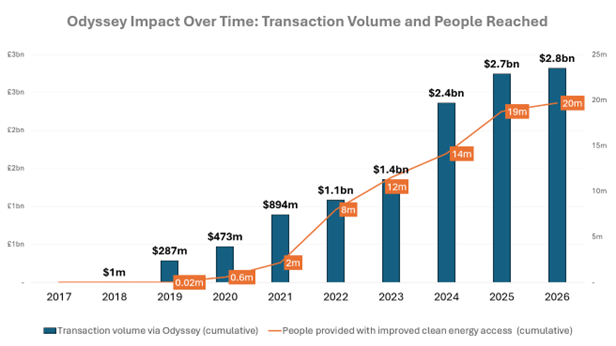
Digitisation can streamline every stage of Distributed Renewable Energy deployment, from project origination to results verification. Through its innovative digital platform, Odyssey Energy Solutions demonstrates this potential at scale: it helps unlock finance, accelerate project development and transparently demonstrate impact, improving clean energy access for 20 million people to date. By bringing structure, efficiency, and trust to a historically fragmented market, Odyssey is transforming how capital flows into decentralised energy solutions.
Background
Distributed Renewable Energy (DRE) technologies are expected to deliver around half of Mission 300’s target of reaching 300 million people in Africa with electricity access by 2030. According to the World Bank, they also offer the least-cost option for bringing electricity to up to 580 million people globally by 2030. Yet, despite this they have historically attracted less than 1% of electricity investments in countries with the lowest access rates.
Unlike large, centralised power plants that feed electricity through national grids, DRE is delivered via a large number of smaller systems like solar home systems, village mini‑grids, and solar water pumps, built where power is generated and used. A major barrier to investing in these decentralised solutions has been the lack of reliable, accessible information: funders struggle to find enough strong projects, compare risks, or verify results because data is scattered across many developers and suppliers.
Since first receiving TEA R&D support alongside the Shell Foundation in 2017, Odyssey has grown to become the world’s largest climate tech investment and asset management platform for Distributed Renewable Energy. Odyssey has grown through unlocking scale-potential for DRE companies by consolidating critical information and tools in one digital platform, giving stakeholders a clear, trustworthy view of projects and unlocking the finance needed to scale clean energy access.
Through Odyssey’s digital platform:
- Financiers can find new investments (including those that have been de-risked through Odyssey’s bridge funding) and manage their portfolio, from due diligence through to results tracking.
- Renewable energy companies can access financing, get credit to procure equipment, and monitor the impacts of their projects.
- Equipment suppliers can list their products, reach new business customers, and even receive aggregated bulk orders.
Since 2017, Odyssey has had over 3,000 distributed renewable energy company users, made over $3 billion of financing available to users, and improved clean energy access for 20 million people.
Building a game-changing platform
Odyssey was designed, developed and started on its journey to scale with R&D funding from the FCDO Transforming Energy Access (TEA) platform and the Shell Foundation. This early-stage support enabled Odyssey to build a platform that now delivers scale, transparency and efficiency across emerging markets.
“The scale of the energy access challenge demands solutions that remove friction at every stage of project development. By digitizing everything from due diligence to procurement and results verification, we’ve helped the most ambitious electrification programs unlock finance more efficiently and ensure that funds reach the communities that need them most. Our goal is to make this level of efficiency and accountability the new normal for the sector.”
– Emily McAteer, CEO, Odyssey Energy Solutions
With this funding, Odyssey ran several pilots to test innovative ways to finance and manage clean energy access projects. These pilots tested business and financing models for electrifying off-grid healthcare facilities, whether results-based financing can improve women’s access to productive-use appliances, and the impact of aggregated procurement on the solar energy supply chain.
Spotlight: Streamlining the supply chain through aggregated procurement
Developers of distributed energy projects in Africa often pay 30-50% more for solar equipment than utility-scale developers (partly due to smaller orders) which is a barrier to scaling energy access. Aggregated procurement, which involves bundling orders from multiple projects and developers, can reduce costs and supply chain inefficiencies by leveraging economies of scale.
Odyssey piloted an approach to aggregated procurement for mini-grid developers in Nigeria, designing a procurement mechanism, trialling two logistics models and testing how its software could support ordering processes. This built on initial testing of bulk procurement mechanisms carried out previously by Odyssey in collaboration with CrossBoundary Innovation Lab, with funding from the FCDO via TEA, Shell Foundation and The Rockefeller Foundation. As part of the pilot, 8 mini-grid developers procured $1.8m of solar equipment (PV panels and integrated storage solutions) for community mini-grid and health electrification projects.
This led to:
- 24% cost savings on solar panels and 40% on batteries.
- Shorter customs clearance times (from 21–28 days to 10–15 days).
- Valuable lessons on the right payment mechanisms and logistics models to use, and the importance of having workflow tools to streamline the process.
- The creation of the Demand Aggregation for Renewable Technology (DART) Program, an equipment financing facility in Nigeria funded by the Global Energy Alliance for People and Planet, and further scale-up investment from British International Investment (see below)
Becoming the digital backbone for Results-Based Finance and mini-grid programmes
The FCDO and TEA, through the convening of the Mini-Grid Funders Group, facilitated Odyssey’s introduction to the World Bank, which led to its involvement in the following two major initiatives.
Supporting one of the most ambitious off-grid rural electrification programmes in history
Odyssey was selected by Nigeria’s Rural Electrification Agency to support delivery of the World Bank-financed Nigeria Electrification Programme (NEP), which aimed to use Results-Based Financing (RBF) to electrify one million households, 250 businesses, and 37 universities.
To do this, NEP needed a fast and efficient way to assess the viability of thousands of mini-grid projects and developer bids, as slow or manual processes would divert scarce resources away from electrification. The programme also required robust monitoring across millions of customers, since funds were only disbursed once developers could demonstrate the delivery of reliable electricity.
Odyssey’s digital platform supported these efforts, processing and analysing data for managing applications, tracking project milestones and impact metrics in real time, and disbursing grants. NEP became a pioneering model for RBF in household solar and mini-grid deployment in Africa. As a result, Odyssey is now supporting similar programmes across the continent, including Clean Energy Inclusion for Africa (CEI Africa) and the Universal Energy Facility (UEF), and funders are increasingly including digitisation in funding criteria.
Providing innovative financing solutions to scale electrification
Odyssey has now also been selected to support the follow-up to NEP, the World Bank-financed $750 million Distributed Access through Renewable Energy Scale-up (DARES) programme in Nigeria, which aims to provide more than 17.5 million people with new or improved electricity access through 1,500 mini-grids and 1.5 million solar home systems.
In addition to providing the platform for DARES, Odyssey brought their DART experience in bulk procurement, together with an awareness of sector bottlenecks from their earlier role supporting the Nigeria Electrification Programme, to develop an innovative new solution: the Odyssey Supply Chain Credit Facility, which has attracted $7.5m investment from BII. The facility enables DARES developers to pre-finance equipment against verified RBF receivables, and to access equipment at volume discounts, with only a small upfront deposit with the balance repaid directly from their RBF allocation once results are achieved and verified.
Repayment from secure grant funding reduces risk for financiers, while equipment suppliers benefit from large, aggregated orders and upfront payments from Odyssey. To date, the facility has enabled over $130 million in procurement with zero defaults. Developers across the continent will also now benefit from an additional $7.5m secured by Odyssey from the Facility for Energy Inclusion (FEI) to expand the platform across Africa.
0 Million
People provided with improved energy access via Odyssey since its launch in 2017
0
Renewable energy companies supported by Odyssey since 2017
$0 Billion
In financing facilitated via Odyssey since 2017
0%
Reduction in the cost of batteries for mini-grids through Odyssey’s aggregated procurement pilot
- 1
- 2
- 3
- 4
- 5
- 6