Leading experts gather in Oxford to strengthen global clean energy research partnerships
Oxford, UK | 7 September 2026
Leading figures from academia, industry and government will gather at the University of Oxford today to strengthen a UK-backed global network dedicated to advancing clean energy innovation and tackling some of the world’s most pressing energy and climate challenges.
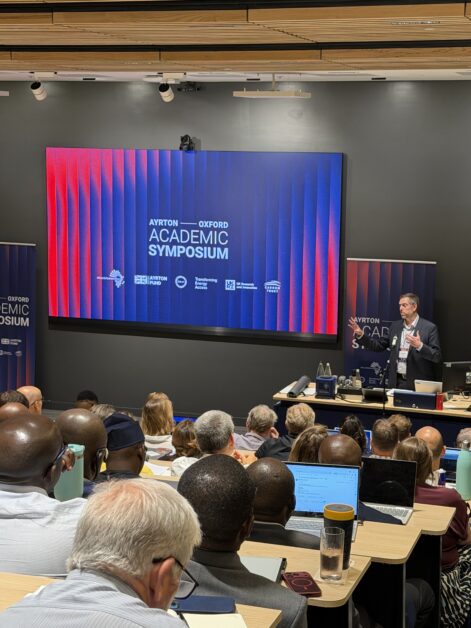
Steven Hunt, Senior Energy Innovation Advisor, Foreign, Commonwealth and Development Office (FCDO)
Convened by the UK Government’s Ayrton Fund, the Africa-Oxford Initiative (AfOx), the Foreign, Commonwealth and Development Office (FCDO), the Transforming Energy Access Learning Partnership (TEA LP) and UK Research and Innovation (UKRI) – the Ayrton-Oxford Academic Symposium will bring together experts from across the clean energy ecosystem, drawing on international expertise and interdisciplinary research to explore how stronger global learning partnerships generating evidence, insights, and innovations can drive sustainable economic growth, strengthen climate resilience and expand access to affordable, reliable energy.
To date, Ayrton-supported innovations have improved access to clean energy for 46 million people across emerging economies, leveraged more than £3 billion in public and private finance and supported more than 256,000 green jobs.
The wider Ayrton network now spans 100 countries and includes 78 universities, alongside more than 840 innovators, academics and delivery partners working to accelerate clean energy progress worldwide. Together, these collaborations have generated 191 technology patent applications and contributed to more than 2,400 research papers, helping transform scientific knowledge into practical solutions with real-world impact.
At a time when countries are seeking faster energy transition pathways to drive energy access and security and economic development, international collaboration is becoming increasingly important in translating research into scalable action. The symposium will examine how both in the UK and overseas, universities, innovators, policymakers and investors can work more effectively together to overcome shared challenges, unlock greater impact and accelerate the transition to a more sustainable and inclusive energy future.
The symposium will open with a keynote address from Professor Sir John Edmunds, Chief Scientific Adviser at the FCDO, who is expected to highlight how the Ayrton Fund has fostered a growing network of research partnerships that combine UK expertise with locally-led knowledge, innovation and experience to deliver lasting impact. He is also expected to emphasise the importance of further strengthening international collaboration to generate the evidence, insights and partnerships needed to support equitable energy transitions, accelerate innovation and build the institutional capacity required for long-term, sustainable change.
This impact is underpinned by a diverse portfolio of Ayrton-supported programmes that are advancing research, building institutional capacity and accelerating innovation. Through the Transforming Energy Access-Learning Partnership (TEA-LP), more than 30 universities across Africa, Asia and the Pacific Islands are helping to develop the next generation of clean energy leaders, strengthening research capability and expanding opportunities for international knowledge exchange. The TEA@SUNRISE network is driving the development and deployment of innovative clean energy technologies through collaborative research connecting more than 400 members across 40 countries and 80 universities in the UK, Africa and Asia. Meanwhile, the Faraday Institution is enhancing global expertise in energy storage, connecting researchers and future leaders through its world-leading battery research programmes and Battery Ambassadors network across 7 African Countries. Across the wider Ayrton Fund portfolio, programmes such as Climate Compatible Growth have built an ecosystem of open-source modelling tools, datasets and lecture materials which have been used by more than 50 universities, while Energy Catalyst and ZE-Gen programmes are helping to translate research into practice by connecting universities, clean energy innovators and industry partners to scale promising technologies with the potential to unlock social and economic benefits across essential sectors such as healthcare, education, agriculture and transport.
Caroline Ward, Senior International Funds Manager at UK Research and Innovation (UKRI), said: “The Ayrton-Oxford Academic Symposium provides an important opportunity to strengthen collaboration between universities, innovators, funders and policymakers across the UK and partner countries. By bringing together global experts, the symposium will help build equitable partnerships, attract investment and accelerate the development of clean energy solutions that support economic growth and climate resilience.”
Professor Kevin Marsh, Director of the Africa Oxford Initiative, said: African researchers will play a critical role in developing solutions which tackle global challenges such as energy access and green transitions. Translating this research into impact on the ground requires interdisciplinary collaboration between research, innovation and investment. This approach underpins the work the Africa Oxford Initiative has done over the past ten years supporting hundreds of outstanding African researchers, scholars and innovators.
Jiska de Groot, Project Lead at the Transforming Energy Access-Learning Partnership (TEA LP), said: “The TEA Learning Partnership is excited to co-convene this symposium, and has been TEA’s first university-level capacity building programme since 2019. For us, equitable partnership means African, Asian and Indo-Pacific researchers leading their own, locally relevant, research agendas, training the next generation of energy leaders inside their own institutions, and shaping how clean energy solutions get designed and implemented.”